Higgs to 4 Leptons (H->4L) Analysis
Intro
This document walks through a complete end-to-end physics analysis using the OneStopCoffea framework, based on the CMS OpenData H$\rightarrow$4L tutorial. A user will interact primarily with analyzer modules and postprocessors, and the vast majority of their efforts will be in programming modules to suit their needs when the existing systems are lacking. Here, we demonstrate how to write bespoke modules when the premade solutions are insufficient. That is particularly true in this case, as the outreach dataset does not exactly mirror the NanoAOD format expected by some of our existing modules.
The code is provided in the examples/higgs_to_4l/ directory.
The Analysis Configuration
The top level description of an analysis is declarative.
This is handled by a central configuration file. In this example, we provide three equivalents: a standard YAML configuration (examples/higgs_to_4l/configuration.yaml), a dictionary-based Python configuration (examples/higgs_to_4l/configuration.py), and an object-based Python configuration (examples/higgs_to_4l/configuration_obj.py).
Pipelines and Modules
The configuration declares three pipelines: FourMuon, FourElectron, and TwoElectronTwoMuon.
These pipelines are seaprate analysis regions, corresponding to the 3 possible leptonic ZZ decay channels detectable by CMS as leptons.
We begin with our custom
OpenDataMuonMakerorOpenDataElectronMaker.For MC samples, we apply a scale factor module.
Depending on the channel we select for the desired number of leptons, among other properties.
We then use these leptons to reconstruct the Z and H bosons.
Finally, the
SimpleHistogrammodule simply books histograms forHiggsMass,Z1Mass, andZ2Mass.
Custom Modules and Physics Logic
While the framework provides many common modules, it is all but guaranteed that something will be missing.
In examples/higgs_to_4l/higgs_to_4l.py, we define the custom AnalyzerModule classes specific to this example.
Postprocessing
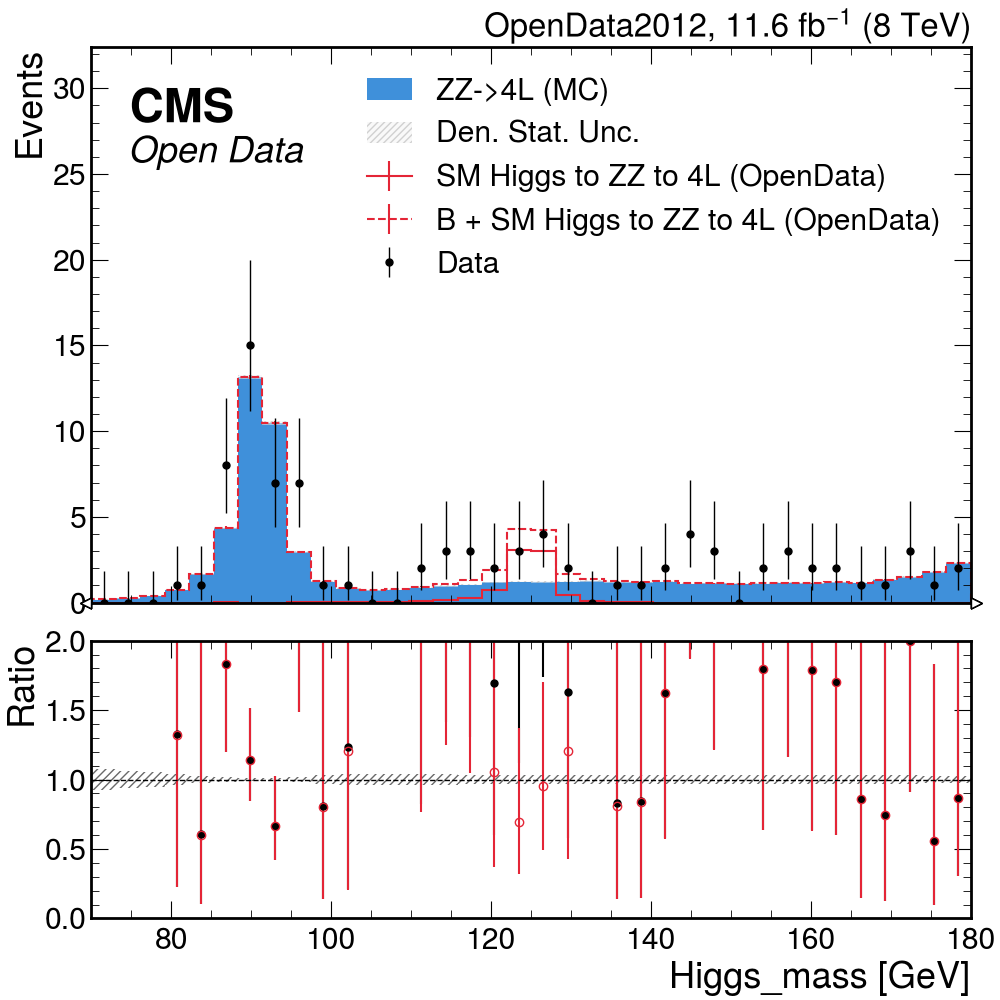
The psotprocessing configuration in examples/higgs_to_4l/postprocessor.yaml shows a complex configuration for producing a “model plot,” which shows how background and signal compare to data.
There are a number of complex features showcased, such as transforms and subgrouping.
The final output of the postprocessor is hown below.